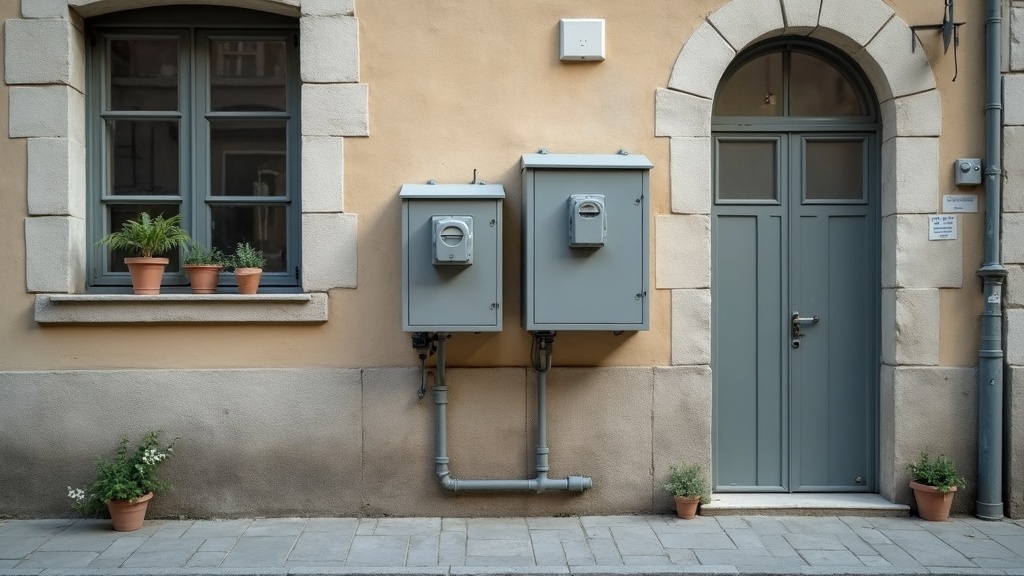
Utilities and standing charges in European homes cover the fixed and variable costs of connecting a property to electricity, gas, water, waste collection and sometimes heating networks. Every country sets its own rules for who owns the meter, who bills the property, and how much of the charge is a fixed “standing” component versus one tied to actual use. There is no single European system, and the gap between countries — and even between suppliers within one country — can be significant. Anyone budgeting for a home abroad needs to check the local structure before assuming it works like utilities back home.
What a “standing charge” actually is
A standing charge is the part of a utility bill that a household pays regardless of how much electricity, gas or water it actually consumes. It typically covers the cost of maintaining the connection, the meter, and the network infrastructure that reaches the property. This sits alongside a consumption charge, which is billed per unit used. Some countries also apply a separate connection or capacity charge based on the maximum load a property is allowed to draw, which is common for electricity in several southern and central European markets.
The proportion of a bill made up of standing charges versus consumption varies by country, by utility type, and by supplier tariff. In some places the standing charge is a small, fairly stable amount; in others it can represent a meaningful share of the total bill even for a property that is rarely occupied. Because these structures and figures change and differ so widely, the only reliable way to know what applies to a specific address is to check directly with the local network operator or supplier, or ask the seller or agent for recent bills during due diligence.
Why the system differs so much by country
Utility markets across Europe sit under different regulatory histories. Some countries liberalised electricity and gas retail decades ago, so households choose between competing suppliers on the same network, each setting its own standing charge and unit rate. Others retain more regionally organised systems where the local distributor and the supplier are closely linked or effectively the same. Water and waste services are frequently municipal rather than national, which means charges can differ street by street depending on the local authority, and a change of municipality on moving house can mean a completely different billing structure.
Heating is another area where the picture diverges sharply. In many Northern and Central European countries, individual gas or electric heating is standard and billed like any other utility. In others, buildings connect to district heating networks, where a standing charge covers shared infrastructure and consumption is metered per apartment or estimated by floor area. Buyers looking at apartments served by a district network should ask specifically how that charge is calculated and whether it is set by the building, the municipality or a regulated operator, since this affects ongoing costs independently of how efficiently the individual unit is used.
Connecting a property for the first time
When a property changes hands, utility contracts do not usually transfer automatically to the new owner or tenant. In most countries someone has to actively open an account with the relevant supplier, provide identification, and sometimes a local bank account for direct debit payments. This is one of the practical steps that sits alongside the paperwork covered during the wider buying process in Europe, and it is easy to overlook amid contracts and completion dates.
For non-resident buyers, opening a utility account can be complicated by the same friction that affects opening a bank account as a foreign property buyer: proof of address, a local tax or fiscal number, and sometimes a requirement that the account holder is physically present or has a local contact. Where a buyer will not be resident year-round, this is one of the areas where a power of attorney arranged for the purchase can sometimes be extended to cover setting up services, though this depends on how the document is drafted and what local suppliers will accept.
New-build and off-plan properties raise a further wrinkle: utility connections may not exist yet at the point of purchase, and the buyer or developer may be responsible for arranging the first connection to the network. Anyone buying under an off-plan arrangement should ask explicitly whether utility connection costs are included in the purchase price or billed separately once the building is complete.
Standing charges when a property sits empty
A second home or an investment property that is unoccupied for part of the year still usually attracts standing charges, and in some countries those charges do not reduce much even when consumption drops close to zero. This matters for anyone weighing the realistic ongoing costs of owning property abroad, since a property that looks cheap to buy can carry fixed utility, service and municipal charges that continue whether or not anyone is living there.
Some suppliers offer a lower “inactive” or minimum tariff for properties that are deliberately disconnected or put into a dormant state, but the terms for doing this — and for reconnecting later — vary and sometimes involve their own fee. Where a property will be let out rather than left empty, the question of who is responsible for utility accounts, and how charges are apportioned between owner and tenant, is one of the practical details worth settling clearly, alongside the wider considerations covered under letting out property owned abroad and the protections summarised in the general shape of tenant rights in Europe.
Renting: who is billed, and how
In rental situations, utility responsibility depends heavily on the lease and on national custom. In some countries it is standard for tenants to take out utility contracts in their own name from day one; in others, the landlord keeps the contract and re-bills the tenant as part of the rent, sometimes with a fixed estimate reconciled annually. Anyone renting before or instead of buying should read the lease carefully on this point, which is one of several items on the checklist to work through before signing a European lease, alongside how deposits are calculated and eventually returned, as described in the piece on how rental deposits in Europe are returned.
Reading a bill from another country
A utility bill from an unfamiliar country can be difficult to parse even for someone who reads the local language well, because the layout, terminology and charge categories differ from what buyers are used to at home. Typical elements to look for include the standing or fixed charge, the consumption charge and its rate structure, any regulated network or transport charge that is separate from the supply charge, and taxes or levies applied on top. Where a bill also references communal charges — for lift maintenance, shared heating, or building caretaking — these are usually distinct from the utility itself and tied to the property’s participation in a shared building, an area closely connected to ownership costs discussed under owning and selling property more broadly.
Because none of these charge structures, rates or thresholds are standard across Europe and they change over time, the only dependable check is the current bill or tariff sheet from the specific supplier or municipality serving the property, not a general assumption carried over from another country.
Frequently asked questions about utilities and standing charges in European homes
Do I have to pay standing charges if my European property is empty?
In most countries, yes — standing charges cover the connection and network infrastructure rather than usage, so they typically continue even when consumption is minimal. Some suppliers offer a reduced dormant tariff, but terms and availability vary, so check directly with the local supplier or network operator.
Who pays utility standing charges, the landlord or the tenant?
This depends on the lease and on national rental custom. Some countries expect tenants to hold utility accounts directly; others have the landlord retain the contract and recharge the tenant through rent. Always confirm the arrangement in writing before signing.
Can I keep my utility contract when I sell a property in Europe?
Utility contracts are generally tied to the property and the account holder, not automatically transferable to a new owner. The outgoing and incoming owner typically each need to notify the supplier separately as part of the handover.
Why is my European electricity bill mostly a fixed charge?
Many countries apply a capacity or connection-based standing charge tied to the maximum load a property can draw, on top of a smaller consumption charge. The exact split depends on the country’s tariff structure and the supplier, so it is worth requesting a breakdown.
How do I set up utilities in a European property I bought as a non-resident?
Typically you contact the local supplier directly, providing identification and often a local bank account or fiscal number. Where you cannot be present, a power of attorney arranged with your lawyer can sometimes cover this step, depending on how it is drafted.
Europe Realtor publishes general information about European property, not legal, tax, financial or immigration advice. We are writers and editors, not estate agents, lawyers, notaries or tax advisers. Rules differ by country and often by region, and they change. Before committing money, engage an independent lawyer in the relevant country who is not connected to the seller or the agent, and confirm your tax position with an adviser qualified in that jurisdiction.